


Cover via Amazon
It is a revelation to infrequent ER visitors to find how much medical service has changed in the past ten years. Hospitals are forced to board patients in hallways for two days or more with marginal care. Patients are seen helping patients because ER staffs are stretched too thin, and hospital beds are full. ERs assume less responsibility for waiting patients who are often not checked in until a long wait has already occurred.
In the 1993 and earlier era when I was in active practice, it was common for hospitals to require ER coverage as a requirement of obtaining privileges to practice in the hospital by providers. This constituted a sort of soft slavery since relatively few ER patients paid the consultants, and from that set of patients came the greatest risk of medical malpractice suits.
Currently, there has been a dramatic shift: Physicians and other providers often refuse to take call or require at least reasonable compensation for their heretofore thankless nighttime, weekend, and holiday work.
Consequently, there has developed a critical shortage of surgeons and other physicians who are willing to take call and to provide emergency and especially trauma services.
Among several reasons are the growing fragmentation of generalists into subspecialties, perceived and actual inadequacies in reimbursement, and new laws prohibiting residents in training from working more than eighty hours a week.
Dr. Maa makes a note of the fact that,
“A staggering three-quarters of hospitals report difficulty finding specialists to take emergency and trauma calls”.
In California, according to the California Association of Neurosurgeons, there not enough neurosurgeons for every hospital to have even one such specialist, let alone full emergency room coverage.
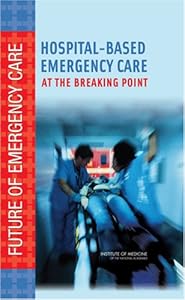
In July 2006, the prestigious Institute of Medicine (IOM) presented a report entitled,
“Hospital-Based Emergency Care: At the Breaking Point“.
The title says it all. The result has been failure of multiple ERs in several states to be able to maintain an adequate level of care by crucial specialties or to survive financially, and they close. Closure of the ERs contributes to the failure of hospitals themselves; so, Americans have fewer hospitals to take care of them; the hospitals available may be less qualified for serious conditions including complicated trauma, and those hospitals are farther away than those that were available ten years ago.
Across the nation, increasing patient volume, declining resources, and a diminishing supply of care providers is a serious challenge for America. The hardest hit are the poor who often depend on the nearest major hospital to provide their care. When that hospital fails, as did Los Angeles County Hospital, what are those impoverished, uninsured, or underinsured people to do?
Leaving aside salient issues of humanism, we need to deal with the staggering financial facts and implications of our health care system and to recognize that the chaotic and inefficient status quo cannot persist indefinitely. Joseph Q. Jarvis, MD, speaking for the Utah Medical Association (UMA), cited some sobering facts and statistics.
Perhaps the most telling is:
“The United Way of Utah published a study of the causes of bankruptcy in Utah, concluding that the cost of illness and injury care contributed to family financial insolvency…”
Every state in the union could make very much the same statement. Harvard University researchers found that the average out-of-pocket medical debt for Americans filing for bankruptcy each year was $12,000, and 50% of filings were partly the result of medical expenses.
Every 30 seconds an American files for bankruptcy in the aftermath of a serious health problem. 25% of Americans reported having problems with housing owing to medical debt including failure to make rent, to make a mortgage payment, or developed a bad credit rating.
A study of Iowans revealed that in order to cope with rising health insurance costs 86% had to cut back on how much they could save; 44% had to cut back on heating expenses and food. Retiring elderly couples will need between $200,000 and $300,000 in their lifetime on average to pay for the most basic medical coverage.
Bear in mind that 77 million baby boomers are fairly rapidly beginning to retire and to become consumers instead of payers into the tax base that supports health care, a significant cost shift from the private to the public sector. Baby boomers began to qualify for Medicare in 2011. Perhaps the PPACA, so highly touted by the Obama administration, will turn around this bleak picture; but I, for one, will not hold my breath until it happens.
According to the NCOHC, Americans spend 4.3 times on health care as on National Defense—17.4% of the Gross Domestic Product (GDP) of the United States. Mark N. Blair, MD, President of the UMA, elaborated with several telling and little recognized facts. He indicated that in 2005 the GDP of the United States was a nearly incomprehensible 1.987 trillion dollars for health care alone ($6,700 per person per year), an increase of 7% over 2004. [That is $5 billion a day.] He said,
“This number reflects many aspects of health care such as personal consumption of goods and services, domestic investments in medical building and hospital real estate, government consumption and gross investments, home and volunteer health production (health food goods and supplements), and labor associated with health care including sports, exercise, recreation, volunteer activities, travel for care, and other health promoting actions.”
USA Today reported that, in an average year, the costs were divided as follows:
Hospital care 30%, physician clinical services 21%, prescription drugs 10%, dental and other professionals 10%, administration 7%, investment 7%, nursing homes 6%, government public health activities 3%, other medical products 3%, and home health care 2%.
New laws notwithstanding, our costs continue to rise. I had a series of illness during the past year, and the cost of medications alone was $25,000. Were it not for Medicare, my wife and I would soon be living out of our car if our expenditures were to continue at that rate.
Dr. Blair stressed that we spend double or even triple the amount on health care as do other countries. We expend over 17.4% of our GDP while Switzerland spends 10.9%, Germany 10.7%.
By 2015 it is estimated that we will increase our costs to over $4.0 trillion—20% of the US GDP. By then every individual in our country will be burdened with a share of the cost exceeding $13,000.
Comparative costs per capita for research and development in the US, in US dollars, came to 61.5, compared to Canada’s 30.9, and the United Kingdom’s 11.08. US private health insurance only pays for 36%; the average annual premium for a family of four in 2005 was $11,500 and $4,200 for an individual, and premium costs for employee based programs rose 7.7% in 2006, an increase of 87% since 2000. Employees themselves contributed 143% more for their insurance since then.
Average out-of-pocket expenditures by Americans under age 65 for health insurance, deductibles, and co-payments rose 115% during the same period. To put those staggering increases into perspective, it is well to note that inflation in the US increased by only 4% per year–a cumulative inflation of 18%, and cumulative wage growth was only 20% in the same period.
The NCOHC made this somber prediction,
“Unless something changes drastically, health insurance costs will overtake profits by 2008”.
Workers contributed 10% more in 2006 than they did in 2005 as employers continually shift health care costs to their employees. In 2005 the federal government paid 34%, state and local governments paid 11%, and individual patients paid 15% out of pocket for health care.
47 million of our citizens had no health insurance prior to 2010; and even after the passage of the PPACA, progress has been very slow to corral the large percentage of our population into the system. 23% of those people have had to make major life changes to compensate and to pay bills. 30% of people polled by USA Today/ABC stated that they had a family member who delayed medical care in the past year and 7% had a problem paying medical bills.
The president of the NCOHC stated that, due to cost increases, “the number of uninsured Americans may have increased, just in 2001 and 2002, by 6 million”. Despite punitive sanctions under the PPACA, the number of uninsured has not appreciably improved nor has the havoc they bring to the rest of Americans who pay a significant portion of the bills they incur.
Costs have continued to rise; The US Department of Health and Human Services reported that in 1970, the average out-of-pocket costs per person was $119, and in 2004 that figure had risen to $788; the annual growth of insurance premiums was 1% in 1996, and 7-16% from 2000 to 2005. The amount spent per person for all health care costs increased by 74% between 1994 and 2004.
National Health Expenditures (NHE) in 2004 were 17.6 times higher than in 1970 while the Consumer Price Index increased by only 4.9% in the same period.
Physicians, hospitals, and prescription drugs had an annual growth rate on average of 8.0-9.0% from 1964 to 2004 while the CPI increased by only 2.7% in that extended period. [HHS Centers for Medicare and Medicaid Services, and Office of the Actuary].
The number of uninsured or underinsured Americans climbs in direct proportion. All negative aspects of the nation’s health care delivery “system” continue to escalate. Perhaps the PPACA will bear fruit and save us from ourselves; it has not done so yet. Perhaps doctors, hospitals, pharmaceutical and medical device companies will rally together to make health care affordable and accessible. We the People will either force a more efficient and frugal system on our country, or we see bankruptcy on national, state, county, city and personal levels. All other democracies in history have failed. It is not at all impossible that ours will also as a result of our profligate inefficiency, greed, and waste driven by our overheated and failing medical care delivery “system”. I use quotes around “system” because we do not have a system. We only have a disparate, inefficient, poorly coordinated, and maybe even irretrievably flawed approach.
To be continued…
What do you think? Share you views, opinions, insights etc. by leaving a comment below.
Carl Douglass – Author
Carl Douglass Books
www.carldouglass.com
“Neurosurgeon Turned Author Writes With Gripping Realism”
To experience Carl’s compelling works, follow the link below:
